Showing posts with label Bertolt Brecht. Show all posts

Thursday, May 1, 2014

Mack the Knife - The Song's Back in Town

As we head into the run of The Threepenny Opera at Signature Theatre, it is slowly becoming obvious why a many guests are coming to see the show. For some people it might be the strong and talented actors that make up Signature Theatre's cast of regulars. For others it might be the strong direction by Associate Artistic Director, Matthew Gardiner. But for the rest of you, I suspect it is one particular song. Might that song be “Mack the Knife”?

Natascia Diaz in Signature Theatre's The
Threepenny Opera
sings Mack the Knife.
"Mack the Knife" or "The Ballad of Mack the Knife", originally "Die Moritat von Mackie Messer", is a song originally composed by Kurt Weill with lyrics by Bertolt Brecht for their music drama The Threepenny OperaA moritat; from mori meaning "deadly" and tat meaning "deed", is a medieval version of the murder ballad performed by strolling minstrels. In The Threepenny Opera, the murder ballad singer introduces and closes the drama with the story of dastardly Mack the Knife. (Interesting side note, Mack the Knife as a character is based on the dashing highwayman Macheath in John Gay's The Beggar's Opera, who was based on the historical English thief Jack Sheppard.)

The song was actually a last minute addition to the musical. The song itself was written and inserted just 24 hours before its première in 1928 because the actor who was playing Macheath demanded another musical number that would more effectively introduce his character. Weill intended the Moritat to be accompanied by a barrel organ, which was to be played by the singer. At the premiere, though, the barrel organ failed, and the pit orchestra had to quickly provide the accompaniment for the street singer.

The song was first introduced to American audiences in 1933 with the first English-language production of The Threepenny Opera. In the best known English translation, from the Marc Blitzstein 1954 version of The Threepenny Opera, which played Off-Broadway for over six years, the words are:

Oh the shark has pretty teeth dear,
And he shows them pearly white
Just a jack-knife has Macheath dear
And he keeps it out of sight.

A dapper and dashing Bobby Darin.
A much darker translation by Robert David MacDonald and Jeremy Sams into English was used for the 1994 Donmar Warehouse production in London (This particular translation is the one being used at Signature.) This new translation attempted to recapture the original tone of the song:

Though the shark's teeth may be lethal
Still you see them white and red
But you won't see Mackie's flick knife
Cause he slashed you and you're dead

 As a "popular" song, "Mack the Knife" was introduced to the United States by Louis Armstrong in 1956, but the song is most closely associated with Bobby Darin. Even though Darin was reluctant to release the song as a single, in 1959 it reached number one on the Billboard Hot 100 and number six on the Black Singles chart, and earned him a Grammy Award for Record of the Year.

Louis "Pops" Armstrong with his trumpet.
Other popular and eclectic covers include ones by Lotte Lenya (1955), Bing Crosby (1957), Eartha Kitt (1959) Bill Haley & His Comets, (1959), Ella Fitzgerald (1960), The Doors (1968), Peggy Lee (1977), Frank Sinatra (1984), Sting (1985), Lyle Lovett (1994), The Brian Setzer Orchestra (2000), and Michael Bublé (2004)

Bretolt Brecht's The Threepenny Opera runs from April 22nd - June 1st at Signature Theatre. Call 703 820 9771 for tickets and showtime information.

Friday, April 4, 2014

Influences and Characteristics of Brechtian Theatre

With Signature Theatre's fast approaching production of The Threepenny Opera, we thought it would be useful to explore some influences on the man himself and just what Brechtian Theatre is and how it will no doubt influence the upcoming production. 

From a young age, Brecht had strong opinions about the ideas, art, events and politics that significantly affected Germany in the first half of the 20th century. Brecht was constantly questioning authority in his plays and forcing his audiences to critique the established order too.


Marxism

Karl Marx
While researching economics for a play in the 1920s, Brecht began studying Marxism. He started developing his “alienation” theory for theatre based on Marx’s ideas about production. Under capitalism, Marx contended that since everything is a product for sale, all human lives, relationships and values become products. The workers become de-humanized and are incorporated into the machinery of production. Brecht applied this idea to theatre, both in content and style. Many of his plays deal with socio-economic problems of capitalism and power, but Brecht also applied Marx’s ideas about production to how his plays were performed. He wanted audiences to see the literal production process of the play, such as the lighting grid or the action backstage, so that they would have to think about the process, not just the final product.

Theory

To appreciate Brechtian theatre, it is necessary to understand two of Brecht’s key theoretical terms:

1.      Epic Theatre - Form of didactic drama presenting a series of loosely connected scenes that avoid illusion and often interrupt the story line to address the audience directly with analysis, argument, or documentation; associated particularly with the German theatre movement led by Bertolt Brecht in the 1920s

2.      The Alienation Effect - Technique designed to distance the audience from emotional involvement in the play through jolting reminders of the artificiality of the theatrical performance.

In his book Das Kapital, Marx argued that, in modern industry, commodities seemed alien because capitalistic production did not reveal the signs of its production. We see the final product without knowing where it came from. The pervading world view of capitalism, where products confront workers as something entirely separate from their makers, was to Marx a false one, perpetuated to the political advantage of the wealthy ruling classes.

This production of The Threepenny Opera uses Brechtian 
techniques such as exposing the sides of the stage 
in addition to commenting about capitalism with the Coca-Cola design. 
Brecht reinterpreted Marx's concept of alienation as a theatrical ideology, in order to displace realism and to show up the hidden agenda of the theatre of the time. Brecht's theatre aimed to provide its audience with ways of looking at bourgeois reality as an unnatural political ideology produced in the interests of profiteering. He wanted to alienate or estrange the audience from everyday reality so that it could be reinterpreted in a new light.

In his essay The Modern Theatre is the Epic Theatre, Brecht stated that his theatre work is based on a "radical separation of the elements of production,” rather than the unity of action seen in Realism. Brecht found this supposedly realistic illusion to be dishonest, in that it seduced the audience to accept subliminally its representation of reality as an unchangeable and apolitical view of the world.
By distancing his audience from the world within the play, Brecht wanted to make audiences aware that stage realism, like life outside the theatre, is made, not given.

Brechtian techniques in The Caucasian Chalk Circle.
The stage is mostly bare; the child is clearly a toy
The German description of Brecht’s alienation effect literally translated means “to make strange.” This concept requires the audience and actors to retain a degree of critical detachment from a play and its performance, to be objective and not empathize or identify with the characters or the events that take place in the play. Some of the techniques Brecht used to create alienation included changing the scenery in front of the audience, projections, treadmills, hoists and musicians on the stage.

Through using these techniques, Brecht aimed to involve the audience in the process of the play's production and what it was communicating. The audience of Epic Theatre is invited to consider and enjoy how the theatre fabricates its fiction, rather than passively accepting an illusion of reality onstage.

Although Brecht criticized capitalism, he was also criticized by the Communist Party for not enforcing social realism and providing solutions in his plays. But Brecht, of course, didn't want to immerse his audiences in “reality” and then tell them what to do. Instead he wanted them to "cry tears from the brain," to absorb messages that they could interpret on their own and then make their choices to act.

Characteristics of Brechtian Theatre
Example of Brechtian Technique: Recent London West End performance of Shakespeare’s Coriolanus had the actors sit in chairs onstage and watch each other perform instead of disappearing offstage when they have said their lines.
Structure: Audience should construct their own interpretation of events.
·        Episodic, disconnected montage of scenes.
·        Often not in chronological order.
·        Purposefully open ended so that the audience needs to arrive at its own conclusion of how the events are linked together.
·        Events are narrated on a grand scale, unrestricted to time and place.

Staging: Audiences should see what’s happening “behind-the-scenes.”
·        Often a bare stage to prevent the audience from being absorbed in the fictional reality of the play’s setting.
·        Exposed stage “machinery” such as the lighting grid and exposed wires.
·        Back wall and wings of stage exposed.

Design: Intentionally shatter the feeling of “realism.”
·        Use of technology to project words and film onto the stage that comments on the performance.
·        Historification – projecting news clips to make the audience put the play into a historical context.
·        Placards that announce when the scene will begin.
·        Design looks mechanical or industrial (i.e. conveyor belts, pipes, wheels)

Music: Meant to comment on the action, not add to the mood of the scene.
  • Discordant with the action onstage.
  • Musicians are onstage with the actors, not “hidden” under the stage.
  • Incorporating popular culture in an ironic way.
Acting & Characters: Keep the audience critical of the play’s heroes.
  • Actors should not be 100% connected to their character.
  • Actors should present their character instead of be their character.
  • Even the “hero” of the story has flaws.
Bretolt Brecht's The Threepenny Opera runs from April 22nd - June 1st at Signature Theatre. Call 703 820 9771 for tickets and showtime information. 

Friday, March 28, 2014

A Big Bertolt Brecht Biography

We are weeks away from the opening of Signature Theatre's production of Bretolt Brecht's, The Threepenny Opera. To better help ourselves, our cast / crew, and our patrons, we thought it would be useful to explore the man himself and a bit of his biography and the background surrounding the show. 

“Art is not a mirror held up to reality but a hammer with which to shape it.” –  Bertolt Brecht


Brecht’s Legacy 

Bertolt Brecht was a German poet, playwright, director and political activist known for his theory and contributions to epic theatre. According to Brecht, a play should first and foremost cause audiences to think intellectually, rather than only aim to emotionally affect them. Brecht contradicted the popular theory that theatre should be as lifelike as possible to create a realistic illusion. Instead, Brecht wanted audiences to be aware that they were viewing a constructed world so that they could critique the characters onstage while they were watching instead of being passive observers swept up in the story.

Biography


Bertolt Brecht was born on February 10, 1898, in the medieval city of Augsburg, part of the Bavarian section of the German Empire. Married in 1897, his father was a Catholic and his mother a Protestant. His father worked in a paper factory. His mother was ill with breast cancer most of his young life, which would later influence the creation of some of the women in his plays. He had one brother, Walter, who was born in 1900.

Brecht was a sickly child, having a congenital heart condition and a facial tic. He suffered a heart attack at the age of twelve but soon recovered and continued his education.
A young Brecht.

Like most students, he was educated in Latin and the humanities. Brecht was exposed at a young age to Luther's German translation of the Bible, whose text appears in many of his plays, particularly Mother Courage and her Children. While in school he began writing. By age sixteen, he was writing for a local newspaper and had written his first play, The Bible. By nineteen, he had left school and started doing clerical work for World War I, prevented from more active duty due to health problems. After the war, he resumed his education at the University, intending to study medicine but becoming more interested in literature and philosophy.

Brecht’s curiosity and exploration extended to his sexual life as well. By the age of sixteen, he began to frequent a brothel as part of a conscientious effort to broaden his experiences. Between sixteen and twenty, he apparently pursued eight girls simultaneously, including Paula Banholzer, the woman who gave birth to his illegitimate child in 1919. He is known to have experimented with homosexuality, often inviting literary and musically inclined male friends to his room on weekends in order for them to read erotic compositions.
  
In 1917 Brecht enrolled as a medical student at the Ludwig Maximilian University of Munich, where he would attend Arthur Kutscher's theatre seminar. Although Kutscher had a reputation as something of a theatrical guru, Brecht was unimpressed. He went so far as to harshly criticize one of the instructor's favorite plays, Hanns Johst's The Lonely One, a biographical drama about the life of nineteenth century dramatist C.D. Grabbe. The impetuous young Brecht suggested that he himself could write a better play on the same subject. The result was Brecht's first play, Baal, an effort that Kutscher considered vile and nauseating.

Drums in the Night (1922)
In 1918, Brecht's studies were temporarily interrupted when he was conscripted and had to serve as a medical orderly in World War I. During this period, he wrote his second play, Drums in the Night, which tells the story of a soldier who returns home from the war to find his fiancée engaged to a war profiteer. This was the first of Brecht's plays to be performed, and his theatrical theories had, apparently, already begun to take shape, for he filled the auditorium with banners instructing the audience not to become too emotionally involved in the proceedings. Drums in the Night, which premiered at the Munich Kammerspiele in 1922, drew rave reviews from Herbert Ihering, and even earned Brecht the Kleist Prize, Germany's highest award for dramatic writing. Thus Brecht, from the very beginning, found himself in the spotlight. That same year, the promising young dramatist married the opera singer and actress Marianne Zoff. Their daughter, Hanne Hiob, born in 1923, would become a famous German actress.

Helene Weigel
In 1924, after receiving productions of The Jungle of Cities at Max Reinhardt's Deutsches Theater and Edward II at the Prussian State Theatre, Brecht moved to Berlin, a move he deemed necessary to continue his dramatic career. During the next few years, Brecht produced a string of well-received plays, the most popular of which was probably The Threepenny Opera, which he adapted from John Gay's The Beggar's Opera along with composer Kurt Weill. In 1929, Brecht married Helene Weigel (he had divorced Marianne Zoff in 1927) who had already borne him a son, Stefan. The new couple also had a daughter, Barbara, who was born shortly after the wedding and who, like Brecht's other daughter, would go on to become an actress.

Brecht and Kurt Weill
However, even as his literary fame was soaring, Brecht found his interests shifting towards politics. In 1927, he had begun to study Karl Marx's Das Kapital, and by 1929 he had embraced Communism. His solidifying political beliefs would soon become evident in his plays as well. Another Brecht/Weill collaboration, The Rise and Fall of the City of Mahagonny, caused an uproar when it premiered in Leipzig in 1930 with Nazis protesting in the audience.

In February 1933, Bertolt Brecht's career was suddenly and violently interrupted as the Nazis came to power in Germany. The night after the Reichstag (German parliament building) was burned down, Brecht wisely fled with his family to Prague. His books and plays were soon banned in Germany and those who dared stage his plays found their productions unpleasantly interrupted by the police.

The exiled dramatist bounced around from Prague to Vienna to Zurich to the island of Fyn to Finland, where he lived for a while in Villa Marlebäck as a guest of the Finnish author Hella Wuolijoki. During this period of exile, while Brecht awaited a pending visa to the United States, he also completed the plays Mother Courage and her Children (1939), The Good Person of Szechwan (1941), and The Resistible Rise of Arturo Uri (1941). In May of 1941, Brecht finally received his U.S. visa and relocated to Santa Monica, California.

Brecht before the House of
Un-American Activities
Unfortunately, Brecht's stay in America would not be as successful or as lengthy as he might have hoped. In 1947, during the years of the "red scare," the House Un-American Activities Committee called the playwright to account for his communist activities. Originally, Brecht was one of several witnesses who had refused to testify about their political affiliations. But on October 30, 1947, he appeared before the committee, wearing overalls, smoking a cigar, cracking jokes, and making constant references to the translators who transformed his German statements into English ones he could not comprehend. Although he outwitted his investigators with half-truths and skilful innuendo, Brecht feared the irrational political climate, and shortly after his testimony took a plane to Switzerland, not even waiting to see the opening of his play Galileo in New York.
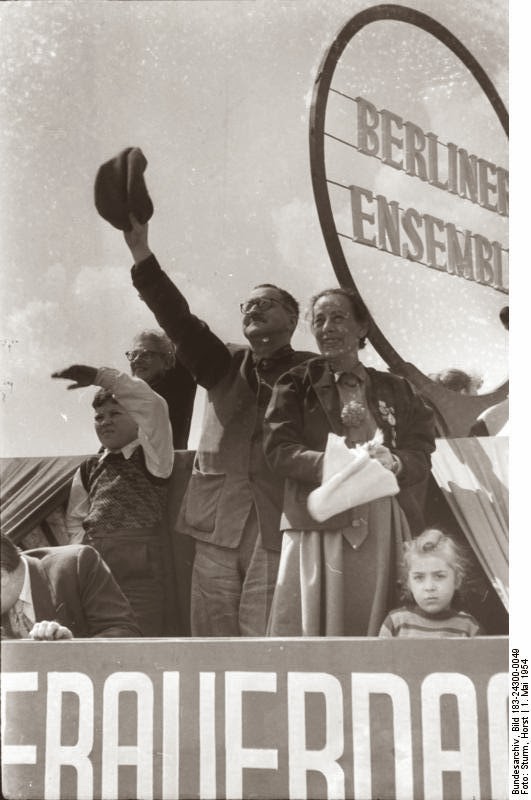
Brecht and Weigel on the roof of the
Berliner Ensemble
On October 22, 1948, after 15 years of exile, Bertolt Brecht returned to Germany, settling in East Berlin where he was welcomed by the Communist cultural establishment and immediately given facilities to direct Mother Courage at the Deutsches Theater. The following year he founded his own company, the Berliner Ensemble, and in 1954 he was rewarded with his own theatre--the Theater am Schiffbauerdamm. Brecht quickly discovered, however, that the German Democratic Republic was not quite his ideal brand of Communism, and he was often at odds with his East German hosts.

Brecht
Brecht wrote very few plays in his last years in Berlin, none of them as famous as his previous works, although he did make some attempts at a play following the careers of Einstein and J. Robert Oppenheimer, and he was said to be contemplating a play in response to Samuel Beckett's Waiting for Godot at the time of his death. In addition, he wrote some of his most famous poems during these last years, including the "Buckower Elegies."

In 1955, Brecht received the Stalin Peace Prize. The following year, he contracted a lung inflammation and died of a coronary thrombosis (heart attack) on August 14, 1956.

Bretolt Brecht's The Threepenny Opera runs from April 22nd - June 1st at Signature Theatre. Call 703 820 9771 for tickets and showtime information. 

Share

Twitter Delicious Facebook Digg Stumbleupon Favorites More